The Arctic tern, the bird my company is named for, spends its life chasing summer from one end of the planet to the other. Every year it flies between the Arctic and Antarctica, a round trip of tens of thousands of miles, so it sees more daylight than any other creature on Earth.
Most of us get to make that journey once or twice in a lifetime. So which pole should come first?
The two are often spoken of together, yet they are wonderfully different places. The Arctic is an ocean wrapped in land, home to people, towns, and animals that walk across the ice. Antarctica is a continent wrapped in ocean, a frozen wilderness with no permanent residents at all. Choosing between them comes down to what you most want to feel when you step off the Zodiac.
At a glance
Wildlife: polar bears or penguins?
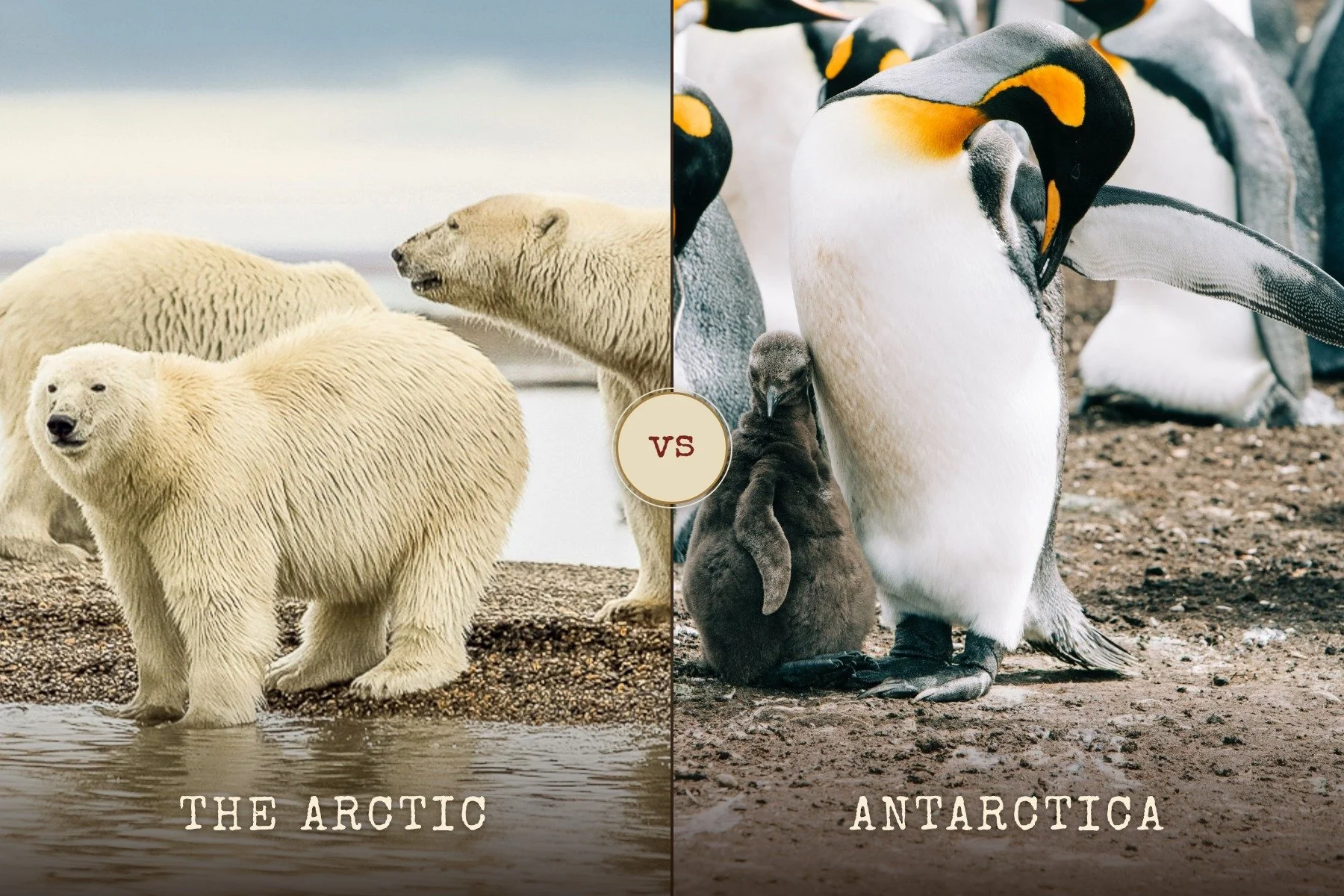
For most travelers, this is the deciding question, and the two poles never share a headliner. Polar bears live only in the north. Penguins live only in the south.
Choose the Arctic if your heart is set on the polar bear. In Svalbard, bears hunt seals along the edge of the sea ice, and June through August is a wonderful window to see them. You may also find walrus hauled out on the beaches, Arctic foxes trotting the shoreline, Svalbard reindeer grazing the tundra, and seabird cliffs alive with thousands of nesting birds. Arctic wildlife sightings take patience. Every bear feels earned.
Choose Antarctica if you want abundance. Here, wildlife comes in the thousands. Gentoo, chinstrap, and Adélie penguins fill their colonies with noise and motion, seals sprawl on the ice floes, and whales feed in the channels. Because Antarctic animals have no land predators, many are remarkably calm around visitors, which makes for unforgettable moments at a respectful distance.
When to go
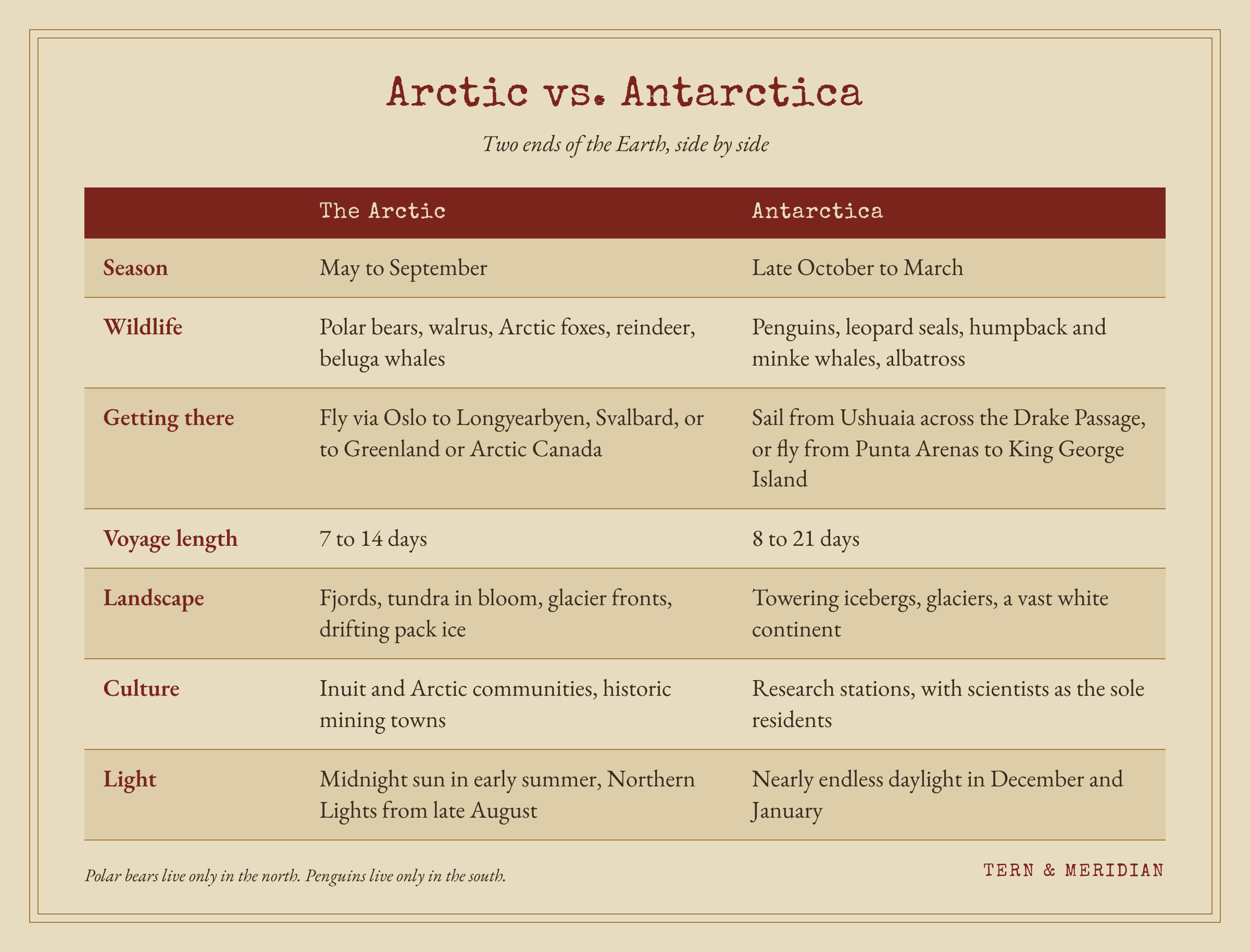
The Arctic season runs through the northern summer. Early summer brings snowy landscapes and the midnight sun. Midsummer brings the tundra into bloom and more open water, so ships can travel farther north. By late August and September, the sun dips again, and the Northern Lights begin to return.
Antarctica's season mirrors it in the southern summer. Early season means pristine snow and penguin courtship. December and January bring hatching chicks and the longest days. February is wonderful for whales, and March offers golden light and fewer ships.
That timing is a gift: a summer Arctic voyage and a winter Antarctic voyage fit neatly into the same year.
Getting there
The Arctic is the easier first step. From the US, you can be in Svalbard in about a day of travel, and many voyages begin almost the moment you land.
Antarctica takes more commitment. Most voyages sail from Ushuaia across the Drake Passage, about two days each way on some of the most famous waters in the world. Some days it is calm. Some days it is legendary. Travelers who prefer to skip it can fly from Punta Arenas, Chile, to King George Island in about two hours and meet their ship there.
Landscape and culture
The Arctic feels lived in. You will find colorful towns, Indigenous communities whose families have thrived in the north for thousands of years, and summer tundra spilling with wildflowers. It is a place of stories as much as scenery.
Antarctica feels like another world. The scale is staggering: icebergs the size of city blocks, glaciers that seem to fall straight into the sea, and silence so complete you can hear ice crackle as it melts. The only residents are scientists at research stations and the penguins, who were here first. Just you, the ice, and the wildlife.
So which should you choose?
Start with the Arctic if you dream of polar bears, want a shorter journey for your first expedition, love culture and history alongside wildlife, or are planning a summer trip.
Start with Antarctica if you want the most dramatic ice on Earth, love the idea of penguins by the thousands, are ready for a true bucket-list adventure, or have time to travel between November and March.
And if you are torn? Many polar travelers find that one pole leads to the other. Like the Arctic tern, you might find yourself chasing summer at both ends of the world.
Plan your polar expedition
Ship size makes an enormous difference at both poles. Smaller expedition ships carry fewer guests, which means more time ashore, more Zodiac outings, and more chances for those wildlife moments you will talk about for the rest of your life.
Explore my Arctic page and Antarctica page to compare ships and routes, then book a consultation and we will find the right voyage for you.