
Journal
A few months ago I started learning Japanese, purely for fun, and let me tell you, it has been challenging, but it has also become one of the most interesting ways I've found to learn about a country. I keep long vocabulary lists sorted by season so the words I'm practicing match whatever is happening outside my window. This fall, one word stopped me right in the middle of a lesson: momijigari. Momiji, maple. Gari, hunt. Leaf hunting! I find the idea so charming, and I love that on the other side of the world, people head out every autumn with one goal, to go find color, and they have been doing it for over a thousand years.
As you can probably tell from each issue, I love getting to know a country in pieces. I want to come away knowing more about a place than I did when I started, through the books I read, the local charities and the missions behind them, and the seasons that make a place special. Some pieces come from grammar drills and a growing pile of words I can't wait to say out loud somewhere they belong. Others come from a country's crafts, where you can feel the care in every brushstroke and every sheet of gold leaf. What I love most about momijigari is the intention baked right into it. Kōyō, the season of turning leaves, is something you go out looking for, map in hand, already wondering what's waiting over the next ridge.
So consider this issue my own leaf hunt, from a few thousand miles away. We start in Kanazawa, where the maples turn a little early and the old samurai lanes light up gold and crimson against centuries-old earthen walls. Then we chase the color south to Kyoto and Nara for the grand finale. You know I can never resist chasing color everywhere I go, so I hope you'll come along for the hunt!
Each autumn, a wave of color moves across Japan, and there is a word for going out to meet it: momijigari, the hunt for red leaves. This issue follows that ripple from Kanazawa on the Sea of Japan coast down to Kyoto and Nara, where the turning of the leaves has been honored for more than a thousand years.
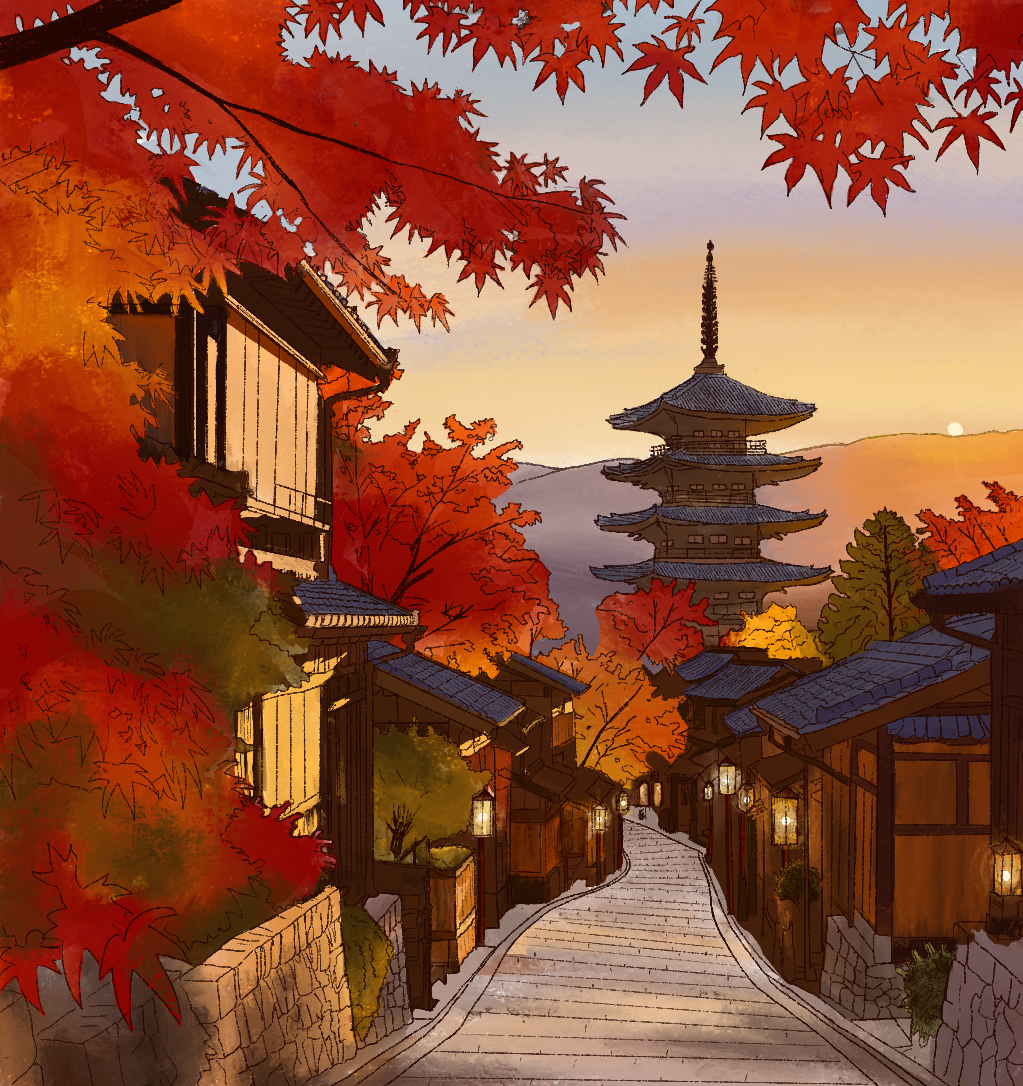
The journey begins in Kanazawa, where the maples turn a little ahead of Kyoto's and the city still carries the shape of its samurai past. In Nagamachi, narrow lanes wind between golden earthen walls, and the Nomura Residence opens onto a small garden of mossy stones, a koi pond, and carefully kept maples. A short walk away lies Kenrokuen, celebrated as one of Japan's three great gardens. In November its ponds hold perfect reflections of crimson leaves, and gardeners climb the old pines to tie yukitsuri, the elegant rope cones that protect each branch from the coming snow. Kanazawa is also a city of makers, producing nearly all of Japan's gold leaf, and that devotion to craft shows up everywhere, from teahouse ceilings to the dessert plate.
From there the route heads south to Kyoto, where the temple grounds reach their peak in late November. Early mornings belong to the maple-lined paths of Eikando and the view from Tofukuji's Tsutenkyo Bridge, looking out over a valley of red and gold. A day in Nara brings ginkgo trees glowing above the gates of Todaiji and deer wandering through the fallen leaves of Nara Park.
This is Japan at its most soulful, a country that rewards those who linger, letting the season unfold leaf by leaf until you find yourself part of a story it has been telling for centuries.
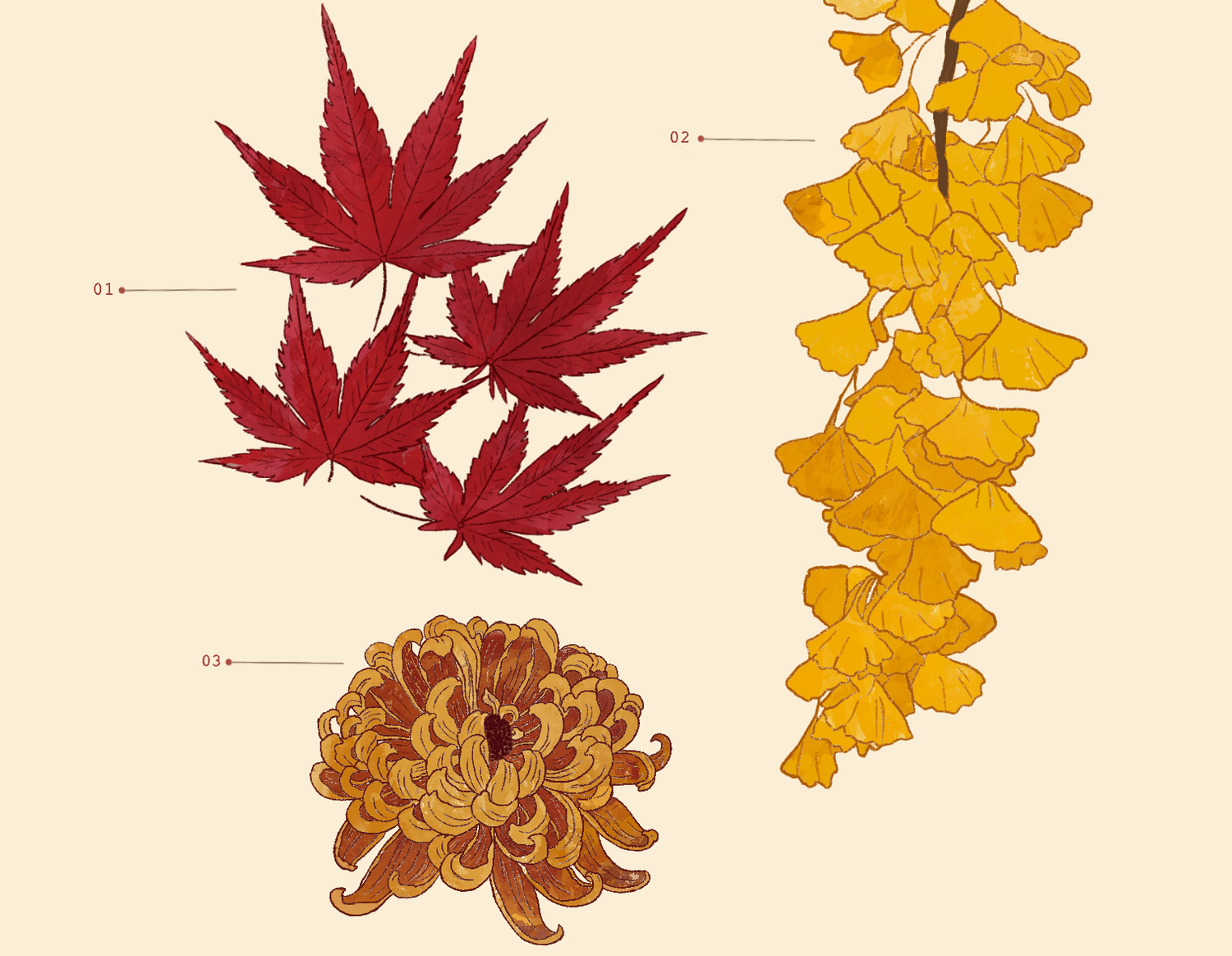
- 01 Momiji (Japanese maple)
- 02 Ginkgo
- 03 Kiku (chrysanthemum)
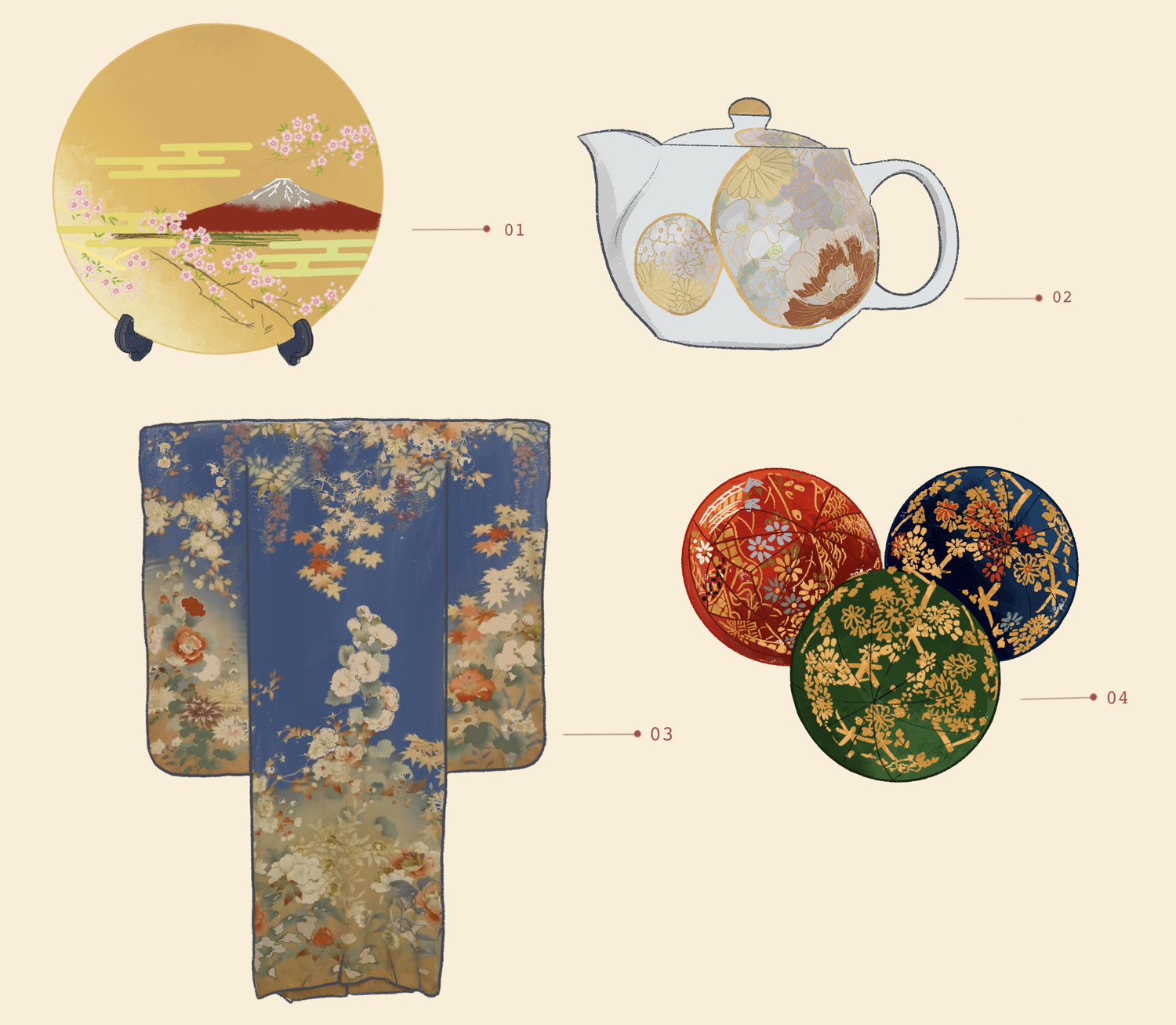
- 01 Kinpaku gold leaf, beaten impossibly thin
- 02 Kutani-yaki boldly painted porcelain
- 03 Kaga Yuzen hand-painted silk dyeing
- 04 Kaga Temari embroidered thread balls, given for luck
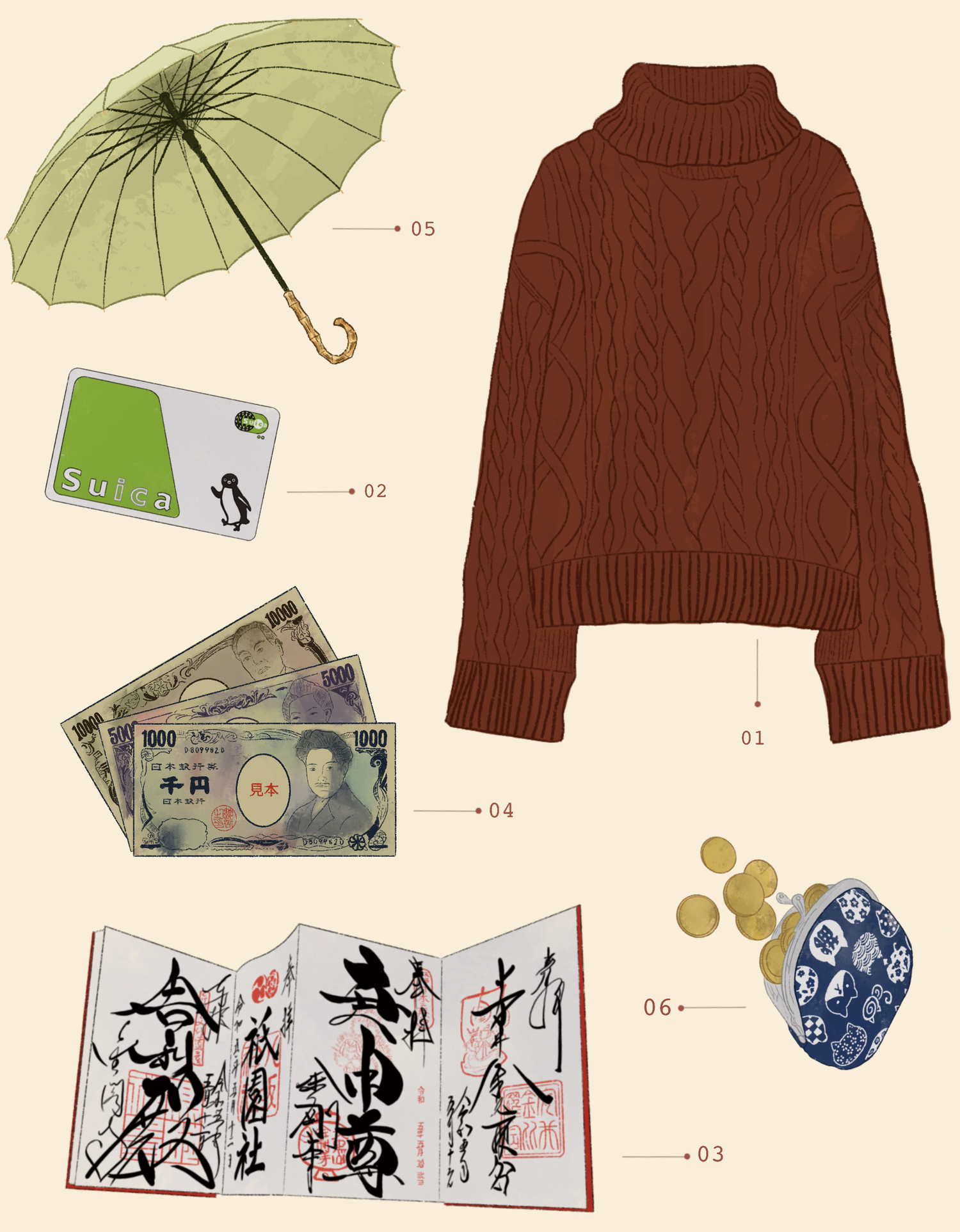
- 01 A warm layer
- 02 Suica card
- 03 Goshuincho (temple stamp book)
- 04 Cash in yen
- 05 Compact umbrella
- 06 Coin purse
Every leaf this issue chases grows from a forest, and in Japan those forests need tending. Nearly 70 percent of the country is wooded, and a large share of that is planted cedar and cypress that grows dense and dark without regular thinning, crowding out the native trees and wildlife that make a forest thrive.
In 2007, the composer Ryuichi Sakamoto and a small circle of friends from the arts founded more trees to bring those forests back into balance. Working hand in hand with local communities, they thin overgrown plantations, restore native woodland, and plant trees abroad where forests are disappearing. The wood they harvest goes to local craftspeople and designers, who turn it into stools, spoons, and building blocks, a beautiful full circle for a country where craft and nature have always been intertwined. Today the organization carries on Sakamoto's legacy under architect Kengo Kuma.
Walk through Nagamachi's samurai lanes and it is easy to imagine a world of perfect honor and discipline. Katsu Kokichi would like a word. Written in 1843, his memoir is the gloriously unfiltered story of a low-ranking samurai who ran away from home at thirteen, begged his way along the great road between Edo and Kyoto, brawled, dealt in swords, and talked his way out of more trouble than seems possible for one lifetime.
It reads like an adventure novel, full of humor, mischief, and surprising tenderness, and it offers a rare look at everyday life in 19th-century Japan, far from the polished version found in history books. Teruko Craig's translation is lively and a pleasure to read. Keep it in your carry-on for the long flight over.
Next November, I'm leading a small group of women into the heart of Tanzania for Under African Skies, a hosted safari with Asilia that runs from first light, to firelight, to starlight. Just 11 spaces left.
View the trip details here →